
Socialism is the past, Socialism is the future. It is an aberration that Socialism is not the present. We are here to correct this tragedy. We fight for a Free British Isles: a Socialist British Isles. Our vision is the British Isles of Social Justice: the British Isles of National Freedom. It is the British Isles freed from Capitalism, Liberalism & Trotskyism.
18 June 2018
Fate's Good Fortune: A Mini Stage Drama by the Rev'd David Parry
One of my experimental Dramas, Fate's Good Fortune, recorded by Paul Obertelli
This is an audio demonstration of David William Parry's mini stage drama "Fate's Good Fortune". The play is about the death, life, & moment in Barzakh (Purgatory) of the former president of Azerbaijan, Heydar Aliyev.

17 June 2018
Socialist Quotes for Sunday Reflection pt 15

Colonisers are those who indebted Africa through their brothers and cousins who were the lenders. We had no connections with this debt. Therefore we cannot pay for it. Debt is neo-colonialism, in which colonisers transformed themselves into “technical assistants”. We should better say “technical assassins”.They present us with financing, with financial backers. As if someone’s back could create development. We have been advised to go to these lenders. We have been proposed with nice financial set-ups. We have been indebted for fifty, sixty years and even more.
That means we have been led to compromise our people for fifty years and more.Under its current form, that is imperialism controlled, debt is a cleverly managed reconquest of Africa, aiming at subjugating its growth and development through foreign rules. Thus, each one of us becomes the financial slave, which is to say a true slave, of those who had been treacherous enough to put money in our countries with obligations for us to repay.
We are told to repay, but It is not about this so-called honour of repaying or not. Debt cannot be repaid, first because if we don’t repay, lenders will not die. That is fore sure. But if we repay, we are going to die!
— Martyr in the continued struggle for African liberation, Capitaine Thomas Sankara (1949-1987)
...............................
Today the discourse of human rights does not only serve to furnish a substitute ideology following the collapse of “great narratives.” By seeking to impose a particular moral norm on all peoples, it aims to restore the West’s good conscience by allowing it to establish itself once again as a model and denounce those who refuse this model as “barbarians.” In history, “rights” have only too often been what the masters of the dominant ideology have decided to define them as. Linked to the expansion of markets, the discourse of human rights constitutes the ideological framework of globalisation. It is before all an instrument of domination, and should be seen as such.
Alain de Benoist
........................
General Remer on the false dichotomy between the West and Islam, created by Zionist media:
The front-line does not run between the Islamic world and the West. The cherished dream of Israel, of the Jewish organisations, and of their media, is to convince public opinion in the West that the Islam is an enemy and a threat for the West, and that all the Jews want is but preventive protection from an Islamic strike force in order to defend the West. Islamism is a world religion that is accessible to all. Judaism on the contrary is reserved for the racist ethnic group of the Jews, the "chosen people".
The witch hunt against the Islam is a tactical propaganda of the Jewish organisations that served at its time to sway public opinion in favour of a war against Iraq. The same tactic is being used today in the witch hunt against Persia. Unfortunately, there are no Islamic media that should be a match for the Jewish media.
...................
We distinguish two levers: on one hand the national idea, that is to say the Fatherland as historic enterprise and the guarantee of a historical existence for all Spaniards; on the other hand the social idea, the socialist economy, as the guarantee of daily bread and economic wellbeing of all the people.
Ramiro Ledesma Ramos
.....................
I think we should think twice about our stance on Technology...
In front of Technology, and Technical development, there are two different tendencies in our Conservative Camp. So, we have those who repudiate Technology and mechanisation in the basis of Vitalism and Organicism, thus Technology is seen as a degenerate by-product of Western Intellect and Willpower, who is the ''enemy of life''. The most extreme view of this conception can be founded in the writtings of Conservative Revolutionary Ludwig Klages (Klages opossed the ''Geist'' (Spirit) to the ''Seele'' which is Human Soul, or Life) but also other KR authors such as Friedrich Reck-Malleczewen and even Oswald Spengler and of course Martin Heiddeger, shows distrust in Technology.
The leftist National-Communist current of German Conservative Revolution supported Total Mechanisation of human existence. The most radical proponent of this trend was of course Ernst Niekisch, but also we can found this techno-bureaucratic tendency in Walter Rathenau, Ernst Junger, and even the Fascist Ramiro Ledesma Ramos. Ernst Niekisch characterised Marxism as an Existentialist philosophy and the Technical worldview by excellence. Why¿
Because Marxism understand the development Human History, from the standpoint of the development Means of Productions, being the development of Technical Means and Tools who the men use to satisfy his existential necessities the main factor of changes in Human Social Regime. So, Marxism is a techno-centric world view.
Ernst Niekisch saw the Bolshevik Total Mechanisation was the basis of destruction of the decadent Bourgeoisie Society based in Individualism, Drunkenness and Subjectivism and the values of 1789 and the rise of a New ``Luciferian`` Civilisation, with a New Man embodied in the figure of Worker, whom he describe as a Demon. A new Civilisation based on Technical values of Hardship, Precision, Total Objectivity and the obedience of the law of the Machine.
This was an opportunity for Germanic Race, through Total Mechanisation whom is resulting from War Communism, they could re-asume their Racial Identity, buried by Western and Latin Capitalism and Imperialism, and its catholic super-structure.
This ideas are very, very alike to Salvador Allende Cibernetism, Cybersyn project and also resembles the Juche Idea with his ´´Man Master of the World, He Rules everything and Decides everything´´ stuff. Also, we found here concepts that remind us the Left Hand Path...
credits to: Jose Stalin
........................
Awaiting the Putin-Nazi Apocalypse
I don’t know about you, but I’m getting a little tired of waiting for the Hitlerian nightmare that the corporate media promised us was coming back in 2016. Frankly, I’m beginning to suspect that all their apocalyptic pronouncements were just parts of some elaborate cocktease. I mean, here we are, a year and half into the reign of the Trumpian Reich, and, well, where are all the concentration camps, the SS units with their death’s head insignia, the Riefenstahlian parades and rallies? Trump hasn’t even banned the Democratic Party, or annexed Canada, or invaded Mexico, or made anybody wear colour-coded armbands. If he doesn’t start Hitlering relatively soon, the oracles of the corporate media are going to have some serious explaining to do.
I don’t think I’m overreacting. After all, back in 2016, The Guardian promised us an “Age of Darkness,” and the end of “civilized order” as we know it. “Globalization is dead, and white supremacy has triumphed,” one of its more hysterical pundits proclaimed. “Donald Trump is actually a fascist,” Michael Kinsley assured us in The Washington Post. Charles Blow of The New York Times warned that Trump’s election was “the beginning of the end,” the descent of the republic into “racial Orwellianism,” whatever that’s supposed to mean. Thomas Friedman called it “a moral 911.” Paul Krugman predicted nothing short of “a global recession with no end in sight.” Jonathan Chait, after heroically vowing not to flee the country with his terrified family, but to stay and fight to the bitter end, guaranteed us that the “monster,” Trump, would “shake the republic to its foundations.”
Perhaps my seismometer is on the fritz, but I haven’t detected much foundation shaking. Yes, Trump repulses me, personally. I do not like the man. I never have. I was based in New York for fifteen years, in the 1990s and early 2000s, before he became a game show host, when he was still just a shady real estate mogul with alleged ties to organised crime who occasionally appeared on Wrestlemania and just generally went about the city making a narcissistic ass of himself and plastering his gold-plated name onto everything. So I have no illusions about his character … the man is an inveterate snake oil salesman with the moral compass of a Tijuana pimp. All I’m saying is, we were promised Hitler, or Mussolini at the very least, and it seems like all we’re getting so far is just regular old narcissistic Donald Trump.
Of course, he could just be laying low and holding back on the Hitler stuff as part of the evil master plan personally developed by Vladimir Putin to systematically brainwash Americans (with state-of-the-art mind-control Facebook ads) into embracing all-out National Socialism and marching through the streets in full Nazi regalia singing Amerika Über Alles… at which point Trump will rip off his mask, reveal his true Hitlerian face, Steve Bannon will suddenly reappear in the turret of an M1 Abrams tank at the head of a division of rebel infantry flying giant Confederate flags as they hideously rumble down Pennsylvania Avenue, and the Putin-Nazi Holocaust will begin.
Or maybe the extremely serious, Pulitzer Prize-winning political pundit David Leonhardt is onto something. In a prominent op-ed in The New York Times, he wonders if Putin’s “secret plan” is for Trump to destroy “the Atlantic alliance” by arriving late for the G7 meeting and “picking fights over artificial issues,” not to mention insulting the Canadian prime minister, which, it doesn’t get much more hair-raising than that. OK, I know you’re probably thinking that sounds like the hopelessly paranoid jabber of some conspiracy theorist nut on YouTube, but we’re talking The New York Times here, folks, and a bona fide “respectable pundit” who wrote a whole 15,000-word ebook and has been interviewed by Stephen Colbert, among his many other distinguished accomplishments.
Examined in the context of other blatantly loony theories the corporate media are currently attempting to ram down our throats, Leonhardt’s theory kind of makes sense. The Guardian, another very serious newspaper, in addition to covering the repercussions of its coverage of Corbyn’s Nazi Death Cult, is hot on the trail of the soon-to-be-infamous Putin-Banks-Brexit Connection. According to “documents seen by The Observer,” a Guardian sister publication, Arron Banks, a “Brexit bankroller,” allegedly had brunch with the Russian ambassador three times, instead of just once, as he had claimed. He was also allegedly offered a piece of some shady gold deal in exchange for the number of someone on Trump transition team, which for some reason it was otherwise impossible to obtain. Or whatever. It doesn’t really matter what happened. The point is, Putin orchestrated the Brexit, presumably as part of his secret plan to destabilise the Atlantic alliance, and then blackmailed Trump into running for president with that “pee-tape” the Democrats paid a former British spook to allege exists.
Paul Krugman of The New York Times concurs. In his latest extremely serious piece of totally respectable grown-up opinionating, he once again calls Trump “a quisling” (he’s developed a fondness for this term, which goes over well with New York Times readers) and reiterates that Trump is “a de facto foreign agent” and that “America as we know it is finished.” Tragically, according to Krugman, the FBI, CIA, and other Guardians of Western Democracy are utterly powerless to deal with this quisling, and his evil puppet master, Putin, because it turns out the entire Republican Party is “hopelessly, irredeemably corrupt.” Yes, it appears the only chance we have to save the world from Trumpzilla, and imminent Putin-Nazi Holocaust, is to elect a buttload of Democrats to office, and eventually an Obama-like Democratic President, so they can launch an all-out thermonuclear war against Russia and North Korea … that’ll teach these Putin-Nazis to screw around with our trade agreements!
Oh, and also, we need to cancel the Brexit, and do away with all these “populist” movements that Putin has fomented all over Europe. For example, according to billionaire George Soros, the refugee-hating League in Italy is likely another Putin-backed front, part of his scheme to “dominate the West.” One can only assume that the AfD, the FPÖ, Rassemblement National, and every other extreme-Right party exploiting people’s rage and fear in Europe are parts of Putin’s grand conspiracy (except, of course, for the Ukrainian Nazis the Western alliance put into power). Soros, like billionaire Bruce Wayne before him, tired of waiting for the West to strike back, is taking matters into his own hands. Not only has he been tirelessly laboring to prevent Donald Trump from “destroying the world,” now he’s financing “Best for Britain,” a campaign to de-brainwash the British people, who, obviously, only voted for Brexit because they’d been brainwashed by the Putin-Nazis.
I could go on and on with this. Have you heard the the one about the Putin-Nazis conspiring with the NRA? How about the one where Emmanuel Macron, in order to protect the French from “fake news,” and division-sowing Putin-Nazi memes, wants the authority to censor the Internet? Or have you read the column in which David Brooks, without a detectable trace of irony, laments the passing of international relationships “based on friendship, shared values, loyalty, and affection” … seriously, he used the word “affection” in reference to the Western alliance, one of the most ruthless, mass-murdering empires in the history of ruthless, mass-murdering empires? Oh,yeah, and I almost forgot … MSNBC’s Rachel Maddow is reporting that the North Korea summit was also orchestrated by Putin!
I’m not sure how much more bizarre things can get. This level of bull goose loony paranoia, media-generated mass hysteria, and mindless conformity would be hysterically funny … if it weren’t so fucking horrifying in terms of what it says about millions of Westerners, who are apparently prepared to believe almost anything the authorities tell them, no matter how nuts. That famous Voltaire quote comes to mind … “Those who can make you believe absurdities, can make you commit atrocities,” he wrote. Another, more disturbing way of looking at it is, people willing to believe absurdities, to switch off their critical thinking faculties in order to conform to an official narrative as blatantly ridiculous as the Putin-Nazi narrative, are people who have already surrendered their autonomy, who have traded it for the comfort of the herd. Such people cannot be reasoned with, because there isn’t really anyone in there. There is only whatever mindless jabber got injected into their brain that day, the dutiful repetition of which guarantees they remain a “normal” person (who believes what other normal persons believe), and not some sort of “radical” or “extremist.”
These people are the people who worry me … these “normal” people who, completely calmly, as if what they are saying wasn’t batshit crazy, explain how Trump is just like Hitler, and how Putin is trying to take over the world. I sit there and listen and smile at these people, some of whom are friends and colleagues, people who I genuinely like, and who genuinely like me in return, but who, under the right set of circumstances, would stand by and watch me marched into prison, or worse, and not utter a word in protest.
CJ Hopkins
16 June 2018
The Post-Revolutionary Society has to be built Now

Why is the world suffering from the machinations of the global capitalist mafia? What has happened to us that has allowed these inhuman monsters to gain such power over our lives? It seems that not many years ago, although intrigue was afoot, the world at large was for all practical purposes immune to the drive towards the global gulag. So what happened to weaken our natural immunity? Why did we let our mortal enemies get the upper hand?
This is indeed a tricky question to answer. It could be suggested that the reason our hidden masters have such power is that we perceive them to have this power. What has changed is that we now have a mass media which presents a false image of the world to us, and by owning that media, our enemies have convinced us that we are powerless to halt their 'progress', and that we really shouldn't waste our time trying to.
The printed word, which offered the opportunity for a great spreading of knowledge, has become a medium for the spreading of ignorance and falsehood. To an even deeper extent, audio, and visual media, have become a source of power for those who seek to control us. This is because the human brain works in sounds and pictures and absorbs more information if presented in a manner which mimics natural interaction and experience. Thus the advent of Hollywood and television has proven to be highly significant in influencing how the world is perceived and how this perception is reflected in how people behave in reality.
Our enemies control the media. They own every major outlet, either directly, or directly by being hold the purse strings through advertising. Thereby, they are the editorial power - deciding exactly which issues will be discussed, and in which manner, and which will be ignored. People who speak of revolution are deluding themselves - the media as it exists is in the hands of the globalists, and so long as they have financial power, that is where it will rest.
'Money', in the form we have come to know it, is an illusion. It is produced at the strike of a key on a computer, and from that moment on exists as a generator of debt. We cannot compete with the globalists by trying to become financially more powerful in the conventional sense, as they control the money supply and can create currency at will. What we have to do is look beyond the playing field that has been concocted for our enslavement, and work in reality, rather than in illusion, refusing to play their game and support their agenda.
How do we escape the web which has been spun for us? The media constantly tell us that we cannot. Well, we can. A key step in our struggle for freedom is to stop listening to the lies which are used to imprison us. How many people watch television from the moment they get home, to the moment they go to bed? Some may convince themselves they are 'selectively' viewing and that by filtering out what they consider the most harmful programmes, music, films etc, they are safe from the influence of the mind controllers. This is rubbish! The powers-that-be are far from stupid. They have created levels of control - some obvious, some subtle - but all designed to manipulate the viewer/listener. The obvious mind control is deliberately obvious, so as to allow the participant of the media circus to consider him or herself to have discovered the game and dodged it. 'I don't watch the soaps, I only watch history documentaries' etc - if this is you speaking, you haven't escaped the mind programming, you have actually embraced it more than those who watch all the drivel on the TV, as you believe what you watch to be fair and unbiased. the solution? Turn the machine off, put it in a cupboard, and when the withdrawal symptoms have worn off (It is an addiction - you will experience withdrawal), bin it!
Freeing your mind from the media is but one step in the march to freedom. It is, however, the most important step. Once you are 'clean' of the media poison, you will come to realise that the media are really powerless. they gain control over us because we invite their toxic propaganda into our minds. Once we no longer partake of their lies, they have no power at all. 'But what will I do if I don't have a TV?' you may ask. Think about that question - what will you do, other than stare at a box in the corner of your room? For a start you will NOT stare at a box in the corner of your room! You will Not be programmed to be a servant to the machine - eating your meals at certain times so you can watch the programmes you just MUST see! You will be free to leave your home and live in the real world. You will be free to talk to your loved ones - about things which really matter. You will be free to explore your desires, to explore the world and to enjoy your imagination. In short, you will be free to begin living in a manner of your choosing, not in the manner designed by those who seek to control you.
This is but the first step. Once you have made yourself aware that the media control is a lie, you will begin to see concrete ways to live outside the wider control of the ruling elite - and then we will take back our power from the minority who rule us, and take back our freedom. Their power is the power we give them. We have to take it back!
As Revolutionary Patriotic Socialists forging the path of Economic and Social Liberation, we have to change ourselves from victims of the system, into combatants who stand outside the system - not combatants in the stereotypical guerilla warrior style, but combatants in the manner of people who have freed ourselves from the control of the enemy. Fighting in chains is futile. We must first of all break those chains.
The chains of forced labour can be broken by engaging in cooperative labour with like-minded people, self-employment, or other forms of labour which are not part of the trap of exploitative wage-slavery.
The chains of staring at the tv can be broken by using the tv as a monitor only, and only watching that which is not a part of the controlled media propaganda.
The chains of neediness can be broken by learning and practicing self-reliance in all areas where we can do things for ourselves - as individuals and as groups of people united in comradeship and friendship supporting and helping each other.
The first step on the road to freedom comes in freeing ourselves. This is the beginning of Revolution. As we free ourselves, we become better able to help others onto the path to freedom, and in this way we build the resistance and create a network that exists outside the control of the liberal tyranny. We need to build the Socialist Republic now, so that when the capitalist system implodes, we already have a better way in embryo, which will be the foundation of the future. And of course, from the strength and security of that network, we can do all we can to hasten the collapse of the hated system of exploitation.
15 June 2018
Home Education or Liberal Indoctrination - an obvious choice

The UK and Ireland share in common a dire education system in which all that is taught is obedience to the anti-values of liberalism. People who are able to keep their children out of the clutches of the liberal mafia will find that although their children tend to outperform those in the system. They will constantly notice discomfort on the behalf of the individuals asking about their child's school, when they are told that he/she doesn't go to a conventional school, but is schooled at home.
Such is the impact of the liberal education system, that the majority of people in the UK, consider it unhealthy, un-natural, and just plain wrong for a child to be educated by anyone other than an accredited teacher. There are even those who don't accept that homeschooling has any validity, and argue that it shouldn't be allowed. In some countries, homeschooling is illegal, and there are those in the UK who would like to see it proscribed here as well.
Why is there hostility to homeschooling? Why do people sincerely doubt the ability of parents to raise and educate their own children? Scare stories in the media and decades of propaganda about the dangers of not being 'normal' members of society, have taken their toll. By 'normal', the propagandists of course mean conformist. Those who dictate behind the façade of democracy, are wary of anyone who does not accept their rule, and use every means at their disposal to enlist the ordinary people into fighting against any threats to their control. Hostility to homeschooling is a result of a refusal to accept that liberalism isn't magnanimous; it is an expression of defence of the prison state for fear of the consequences of freedom, such as responsibility, self-reliance, and having to think, act and feel for oneself.
In the UK, to become a teacher, one has to undergo a one year post-graduate course. Yes, one year! The course deals with how to control a class of 30 or more children, and how to implement government social-engineering lessons. The knowledge of the teacher from his or her chosen university degree course may, or may not, be useful in teaching, dependent upon which subject or subjects he or she is to teach.
When one begins homeschooling, it really doesn't matter if one is educated to degree level. Understanding the complexities of Statistical Analytical Procedure, or the different strands of thought involved in the Sociological study of Gender Identity Issues (or other such piffle), really does not help when it comes to teaching a child to read and write, to grasp the fundamentals of mathematics, or to do art and crafts.
Education is a vital part of a child's development, but the regimentation of education is un-necessary, and indeed injurious to the child. Regimented education prepares the child for his or her place in the class system. For those who are educated in the State sector, the strict conformity to the bell/buzzer, and the absolute insistence that the Teacher is always right, prepares the child for a subservient role in the economy. For those educated in the fee-paying sector (the bizarrely named Public Schools), the emphasis is on preparation for a managerial role, and the more expensive the school, the higher the level of management and of power in adult life. Thus, the Institutional School System, ensures the continuation of the Class System, and of Materialism as the be-all and end-all of life.
In official schools, the emphasis is clearly placed on conformity and obedience. Freedom of thought is forbidden, and where it raises its head, it is punished. In History lessons, children are taught that the British are basically evil due to their involvement in the African Slave Trade. Woe betide any child who dares to mention the fact that it was the Ruling Class who created the Slave Trade, and that Working Class Britons were enslaved by the Ruling Class and their collaborators before the same tragedy was inflicted upon Africans. Anyone who dares to question the official fantasy version of history risks punishment which could include prosecution for thought crimes. Schools exists to disseminate propaganda, not to impart knowledge.
Homeschooling is time consuming, and it is not without costs. Teaching materials, pens, paper, and all the paraphernalia associated with education, have to be bought. There is no refund of taxes for not using the Establishment system, thus homeschooling effectively means paying for one's child's education twice over. However, monetary considerations should not be paramount. Yes, homeschooling requires sacrifice, but having children requires sacrifices.
A misunderstanding of homeschooling is that the education a child receives at school is superior to that it can receive elsewhere. This is nonsense. A child learning at home has the complete attention of the teacher, and even where there is more than one child present, the ratio of child to teacher cannot be as high as that in an external school. It is argued that discipline suffers when a child is at home; those who argue this may be referring to their own inability to discipline their children, but that doesn't mean that all parents are lazy or incompetent in looking after their own.
Home-schooled children tend to work harder than other children, and have fewer long holidays. They certainly do not have the chance to avoid doing work set for them, and if they ever utter the words 'my dog ate my homework', the chances are it will be true!
The State actively encourages parents to hand their children over to nurseries and pre-schools before giving them to more strangers in the school system itself. It is not uncommon for a child as young as one year-old to be given into the care of non-family members. If parents are willing to abrogate their parental responsibility in order to gain material wealth, then they do not deserve to have children at all. Such parents reduce themselves to breeders of the next generation of producer-consumers; victims of the anti-human State.
Do you want your children to be indoctrinated with globalist propaganda? Do you want them to be taught that there are more than two genders, and that feelings are more important than facts? Do you want your children to grow up supporting NATO's wars against humanity; to have no love for anything but materialism; to have no culture; to have no spiritual or intellectual goals? Or do you want them to be free, feeling, thinking, intelligent, articulate, questioning human beings?
Homeschooling is more important than ever now that there are more failing schools than ever, increased class sizes and easier exams. Also the very fact that the liberal dogma effectively means that bright kids are ignored in the class room so that more time can be spent on thick and/or disruptive kids means that a decent education in a state school is very unlikely.
Children can get all the socialising they need from clubs and extracurricular activities. The socialising in schools is unnatural and bullying, peer pressure and pecking orders always establish themselves.
Unless you are happy for the liberals, capitalists, globalists and trotskyites to destroy your children and any hope of them achieving a future of moral, cultural and spiritual worth, then you will do all you can to keep them out of the School System. The citizens of many countries are legally barred from home educating their children. In the UK we are still allowed to raise our own children as we see fit. If we do not make the fullest use of this opportunity, then we are collaborators with the destruction of society, and deserve the evils which our enemies are striving to make our reality. The prison door is closing. We have the chance to put a foot in the door and empower the next generation with the tools to restore freedom. This is a chance we cannot afford to miss.
SMPBI members and supporters are encouraged to do all they can to limit the influence of the liberal indoctrination system on children they are responsible for. If you can home school, you should. In the coming Republic, education will be the responsibility of the community, with all teachers and children knowing one another, and no strangers involved. The education that we would give our own children now, is the education we want for the nation when we sweep away the decadent parasitic system of today. Our children deserve our fullest commitment; nothing less will do.
14 June 2018
Sajid Javid: Zionist Tory Banking Tyrant; Enemy of the NHS and the Working Class Worldwide
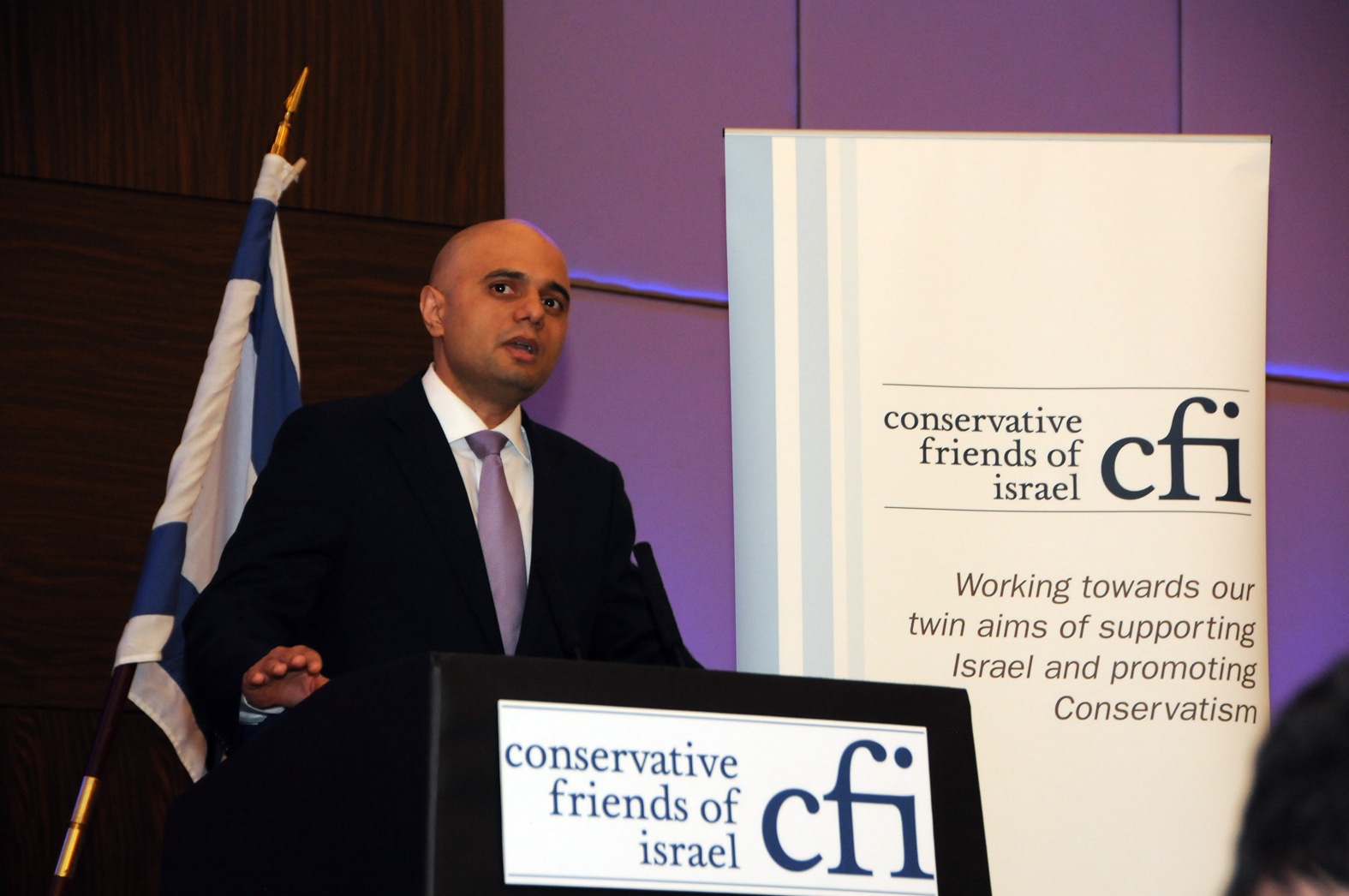
The Home Secretary Sajid Javid, will tomorrow lift all restrictions on non-EU people working in the NHS. He will effectively open the borders to anyone from anywhere in the world (except the EU), as long as they claim to have a background in healthcare.

Who is this Sajid Javid who is playing loose and fast with our sovereignty? Javid was born in Rochdale to Pakistani immigrants. In 1995 he began working for Chase Manhattan Bank in New York and South America, followed by Deutsche Bank in London and Singapore, having a working lifetime in the heart of the Globalist Capitalist Banking Criminal Network for 14 years. He progressed to Managing Directorship level. He has Global roots, Global experience and is committed to furthering the cause of Globalisation.
Javid left Banking to go straight into a safe seat for the Tory party, becoming an MP in 2010.

As well as a career in Banking, Javid is a confirmed Zionist, who has stated that should he be offered the chance to live in the Middle East, the only country he would want to live in is Israel. He used his position as Communities Secretary to attack councils who supported the BDS movement and in this way increased the power of the Zionist stranglehold in British politics. He is - of course - a member of the Conservative Friends of Israel, aka the Conservative Enemies of Palestine and Freedom Anywhere.

In 8 short years as an MP, Javid has advanced at a rate which is even surprising for the corrupt Tory party, to now hold the position of Home Secretary. Clearly being an ex-Banker, a Globalist and active Zionist, is the key to success in the Tory ranks.
His announcement that the NHS should be filled to the rafters with non-EU workers, is an affront to the people who voted for Brexit. We voted to secure our borders, not kick them wide open. But more than this, it is an attack on the Working Class in Britain, who will be denied work, as cheaper imported labour will once again be used in place of training the unemployed.
The NHS does need more skilled staff. Importing skilled staff from other countries - especially underdeveloped ones - is a drain on those countries. It is a form of racism, to attack countries economically - as Javid's banking colleagues do - then to steal the best workers from those impoverished countries to staff the NHS. Every country needs its best people to help it develop. Stealing the best from other nations is to cause a brain drain and to cause skills shortages in those countries, which will of course, further impoverish them. SMPBI is outraged at this racist attack on poorer nations, which will become poorer still as a result. Javid is a Banker at heart, and does not care that it is the likes of the World Bank and IMF which are destroying the underdeveloped world. He is a Globalist who has no respect for Borders and National Integrity.
SMPBI calls for British Jobs for British Workers. Our People must come first. If there are skills shortages, there must be free training for the Working Class to fill those shortages. We call for an end to the disgusting abuse of foreign countries which comes in the form of draining them of their best workers rather than train our own citizens.

Sajid Javid is an absolute disgrace. His identification with the Zionist menace is a clue to his character. He respects Israel and attacks those who oppose the brutalisation of the people of occupied Palestine. Javid is living proof that it isn't only the liberal globalists who are a danger to freedom, but all globalists. If the countries destroyed by Bankers like Javid were free from the capitalist sickness, they could have their own NHS's, and their own people could help to raise the standards of those countries. If the British Isles were free from these political and corporate parasites, we too could have an NHS staffed with our own Workers, with Class and National Loyalty making our lands better places in which to live.

Javid personally gained by accepting payments from the Fracking Industry to overturn the democratic decision of Lancashire County Council to ban Fracking in Lancashire. The man who claims to care about the NHS, took payments to bring in unsafe practices which are linked to decline in health in people living in affected areas. Lancashire is 120 miles from where Javid is an MP, and much further from where he sits in London. The Tories will sell off the NHS at the first opportunity. Javid has as much respect for the NHS as he has for the People of Lancashire who he sold out so his corporate friends could make a killing in an industry which has very serious questions as to its safety. He is corrupt to the core - a perfect Tory!
Javid has to go, and so does the entire corrupt Globalist Zionist system.
Save our NHS. Train our People. Stop the Exploitation of other lands. Close the Borders and Stop the Parasitic Skills Drain, which in turn impoverishes not only the lands of the immigrants, but also our own.
13 June 2018
Uniting Hegel, Husserl and Heidegger - Wilberg on Wednesday

MIKE KOSOK CA. 1981
(1927 – 2015)
The Dialectical Phenomenology of Michael Kosok
Biographical Preface
The larger-than-life man to whom this essay is dedicated and without whose genius and inspiration it could not possibly have been written, is in all likelihood long dead. I first encountered Michael Kosok in 1975, when he was still professor of physics and mathematics at Fairleigh Dickinson University, New Jersey. For over two decades now he has disappeared from trace, his extraordinary writings on philosophy and science now seemingly consigned to oblivion – never published save for a few articles in the journal Telos. From him comes the term ‘dialectical phenomenology’ which is the subject of this work — a homage to his genius and a belated recognition of the immense influence he exerted on my own life and thought. Mike himself favoured another term for his own philosophy – the Life and Science of Paradox – a life he lived through his appreciation of energy as dynamic relationality, and his unsurpassed grasp of the “Dialectics of Nature” – the circular and paradoxical dimension of relationality in all domains and at all levels, from the sub-atomic to the social. With this essay a circle in my relationship to Mike is also completed, one that began in my last year as an undergraduate at Oxford with the discovery of his seminal article entitled “The Formalisation of Hegel’s Dialectical Logic”. Thirty years later (2004), I find myself having come full circle from this beginning in my own writings on phenomenological medicine and psychotherapy, and the dialectical phenomenology of the human organism. The completion of a circle is not a closure but an opening, for the circle is no less defined by what it rings and bounds as it is by the unbounded field that opens up around it and the infinite possibilities of inward expansion that this field opens up. The same I believe is true of the circle of life that we see beginning at birth and ending at death. I am sure that Mike is even more fully aware of this now than he was when I knew him. Though I cannot locate his body in space and time, the ‘non-localised field of awareness’ that constituted his being and brought life to it is anything but dead.
Introduction
Physical science is based on a belief in miracles — the miraculous emergence of awareness itself from an otherwise non-aware universe of matter and energy – a universe we couldn’t even know about without our awareness of it. It seeks to explain our capacity for conscious awareness through studying particular phenomena within our own field of awareness — for example the physical body or brain. The terms ‘physical’ and ‘physics’ derive from the Greek verb phuein – to ‘emerge’, ‘arise’ or ‘manifest’. Physics offers explanations of how things emerge or arise but does not begin by recognising them as phenomena emerging or arising within a field of awareness. From a phenomenological point of view, however, the known universe is not merely a universe we are aware of – it is the universe of our present human awareness. The focus of phenomenological science is not preconceived ‘things’, but the nature of those things as phenomena manifesting in a field of awareness. Dialectical Phenomenology is concerned with the physical dynamics of phenomena in the root sense of this term – the process by which phenomena emerge or arise, not as objects for a localised or ‘punctual’ subject, but events arising from and within a non-localised field of awareness – indeed as the self-manifestation of that field. Dialectical Phenomenology belongs to the very essence of Marxism as a “human science of nature and a natural science of man”, distinct in principle from both the Hegelian dialectic and Husserlian phenomenology. Hegelian dialectics lacks a full phenomenological basis. Husserlian phenomenology lacks a full dialectical understanding of the field character of subjectivity and its field dynamics – the dynamics of inter-subjectivity and relationality. For Husserl, consciousness was always conscious of something. For Michael Kosok there are no ‘things’ to be conscious of in the first place. The world is not a step-by-step linear ‘construction’ or ‘evolution’ of complex wholes from separate, pre-given elements which enter into relation with one another — or with a perceiving subject. Instead all elements are, to begin with, not elements in relation but elements of a dynamic relation, constantly defining themselves through that relation and constantly being transformed by it. We live, according to Mike, not in a world of things but a world of ‘-ing’. Ultimately ‘being’ as such is a verb (‘be-ing’), but a verb without a pre-given subject, an activity without a pre-given agent. Subject and object, self and other, are distinct but inseparable dimensions of a singular boundary state of dynamic relationality or interactivity, one which defines itself and all ‘selves’ or ‘subjects’ through its dynamic process of self-manifestation and self-differentiation – of ‘selving’. Husserl was right in one sense: our awareness of ourselves is always an awareness of ourselves in relation to something or someone other-than-self. But that relation is itself a circular one – one in which self and other define themselves in and through their mutual relation, as distinct but inseparable aspects of a dynamic field of interrelatedness whose self-expression is what they both essentially are.
BRIEF DEFINITION OF DIALECTICAL PHENOMENOLOGY
A unified field theory of awareness: awareness being understood as a non-localised, field of relatedness and inter-subjectivity which is the condition of appearance of any localised objects for a localised subject.
THE PRINCIPLES OF DIALECTICAL PHENOMENOLOGY
1. The basic phenomenological principle
All phenomena are localised self-manifestations of a non-localised field of awareness.
2. The basic dialectical principle
Any phenomenon manifesting within a field of awareness as a bounded entity (a posited presence or ‘thesis’) is co-defined by its immediate context of appearance (its ‘antithesis’). Examples of thesis and antithesis are figure and background, organism and environment, particle and energy field.
“Neither exists as an already well-defined entity outside of their mutual boundary relation…the so-called synthesis or unity of opposites is not a construction of opposites but rather the opposites are nothing but inseparable sides of a singular boundary state…” (Michael Kosok)
3. The principles of dialectical ontology
All fields of awareness, and the phenomena that manifest within them are the expression of a universal ground state of awareness which we call Being. The ground state of awareness is not awareness of anything. It is the being of awareness – itself inseparable from the awareness of being. The being of awareness is ‘no-thing’. Nor is it nothing. It is the field condition for our awareness of ‘any-thing’. The awareness of being is awareness of no-thing. It is the condition of awareness of any-thing. The ground state of awareness is both formless and the source of infinite formative potentials. Formlessness and form, potentiality and actuality, non-being and being, no-thingness and thingness, are inseparable aspects of a singular boundary state of ‘becoming’ – or ‘be-ing’. The ground state of awareness or “Being” is a state of dynamic actualisation or Be-ing, constantly giving form to its own formative potentials, and constantly transformed by them.
4. The Gestalt principle (dialectic of figure and ground)
All phenomena are forms or figurations (‘Gestalts’) arising from the universal ground state of awareness.
All figures that emerge from this universal ground state of awareness (Being) are also particular figurations of awareness (beings).
As a figuration of awareness, every figure that emerges from the ground state of awareness configures its own field of awareness.
A being is no more or less than a particular pattern, figuration or ‘Gestalt’ of awareness: one which configures its own awareness of other beings – the way it perceives them as phenomena within its own field of awareness.
The universal ground state of awareness (Being) is a source both of infinite fields of awareness (beings) and the infinite phenomena manifesting within those fields.
An example of the figure/ground dialectic:
A fish is a part of the oceanic ‘field’ in which it lives and at the same time an individualised self-expression of that field — a fishly form of the ocean as a whole. The fish is also distinct from the oceanic environment around it and from the other fishes within it. All oceanic life forms perceive both the ocean as a whole and other organisms within it in their own unique way, for their own unique organising field-patterns of awareness each create a uniquely patterned field of sensory-perceptual awareness – their ‘ocean’. Sharks, for example, perceive electrical fields of other organisms and experience the ocean itself as an electrical field and not merely a tactile, visual or auditory one. The ocean, in this analogy, can be compared to the universal ground state of awareness or Being which gives rise to a multiplicity of foreground ‘figures’ in the shape of fish and other life forms. Yet each of these figures in turn shapes its own ‘background’ field – constitutes its own patterned environment field of awareness or ‘ocean’. The ocean as such, as a ground state of awareness, is not reducible to a singular environmental or ‘background’ field common to all the life forms that ‘figure’ within it, but is a field of fields or ocean of oceans. What the ocean as such or any other oceanic life form within it essentially is, cannot be reduced to the way it is perceived as foreground figure or background field by other life forms – each of which perceives both the ocean as a whole and all the life forms within it in a way configured by their own organising field-patterns of awareness. If Being is a ground state of awareness then the relation of Being and ‘beings’ can be compared to the ocean’s awareness of itself as ocean, and its awareness of itself in the individualised form of each of the life-forms that it gives rise to. The self-awareness of these life forms is their awareness of themselves and each other as a part of the ocean as a whole and as self-expressions of it - both distinct but inseparable from it. Only a fish with a human-like ego awareness would experience itself as a being separate and apart from the ocean as a whole and other life forms within it, and regard its own uniquely patterned perception of the ocean and its life forms as more ‘real’ or ‘objective’ than those of a fish or shark.
5. The principle of irreducibility (dialectical asymmetry)
Being cannot be reduced to beings.
The universal ground state of awareness cannot be reduced to any particular figurations and fields of awareness it gives rise to.
A given field of awareness cannot be reduced to or explained by any phenomenon manifesting within that field.
Examples:
A nightmare cannot be reduced to or explained by any event experienced within it.
A text cannot be reduced to or explained by a single word, sentence or paragraph within it.
Similarly, the awareness we possess as human beings cannot be reduced to or explained by any phenomenon manifesting within our field of awareness: for example the human body or brain as we perceive it within that field.
6. The holarchic principle (dialectic of whole and part)
The universal ground state of awareness is not just a whole that is more than the sum of its parts: a ‘holistic’ field of awareness in which particular figures manifest. Since every figure emerging from the ground state of awareness configures its own field of awareness, the universal ground state of awareness is a holarchic field – a whole of wholes or a field of fields.
Every part is a self-manifestation of the whole, one which in turn transforms the whole.
Every phenomenon manifesting within a field of awareness is a self-manifestation of that field, one which in turn transforms that field.
Every patterned field of awareness emerging from and within the ground state of awareness or Being, is a self-manifestation or ‘selving’ of that ground state – thus assuming the character of a self or being.
Being, as the sum of all that is, is not just an absolute or infinite whole made up of finite parts — beings. Nor is any whole – even an absolute whole - merely the unity of its parts. For each part is also the unity of all the wholes of which it forms a part – up to and including any absolute or infinite whole. Each part being the unity of all the wholes or fields of which it forms a part - and a self-manifestation of any absolute or infinite whole or field - beings are themselves absolute, infinite or holistic units – ‘holons’.
7. The principle of form (dialectic of foreground and background)
Every phenomenon that manifests within a field of awareness appears as a foreground figure which co-defines its own background field. Foreground figure and background field are distinct but inseparable aspects of a singular unitary or ‘holisitic’ field of awareness within which they arise or emerge, a field which includes both. A prominent object in a still-life painting appears as foreground figure against a background field. The holistic field – the painting as a whole, includes both the object and its background.
Foreground figure and background field (for example a black object against a white background) are also inseparable mutually-defining elements of a singular boundary state – the form of the figure as such. What we see as a ‘black’ circle surrounded by a white background could just as well be seen as a ‘white’ circle with a black interior. The circle as such – the form or figure — is not black or white. It is both and neither. Similarly, what we perceive as spherical bubbles of gas in a fluid medium could just as well be described as bubbles or spheres of fluid containing gas. Just as the circle as such is neither black or white so is the sphere as such neither fluid nor gaseous. A form is reducible neither to a foreground figure or text nor to a background field or context. It is a dynamic boundary of distinct but inseparable elements. Any ‘body’ is essentially a bounded form or figure – defined not simply by what it surrounds and contains but also by all that surrounds and contains it. The principle of form offers a new understanding of biological forms and of bodyhood as such - not as something intrinsically bounded but as a dynamic boundary between the inner and outer fields of a form or figure.
8. The principle of relationality (dialectical logic)
A field is not composed of separate elements placed in a certain formal relation to one another. The elements are themselves elements of their formal relation, distinct but inseparable sides of a singular boundary state of determination, like two sides of a coin or the inside and outside of a circle or sphere. All elements of any field are circularly self-referential, defining themselves through their relation to other elements in the field — as an organism, for example, defines itself through its relation to its environment and to the other organisms within it. From the simple antithesis of seemingly separate entities – organism and environment — the dialectical principle of relationality allows us to understand the reciprocal relation of organism and environment as a relation internal to both. For the environment of an organism is itself an environment of organisms — an ‘eco-system’. Conversely, each organism constitutes its own sensory-perceptual environment. In the case of human beings, the dynamic relation of the human organism to its environment becomes one element in an internal relation of the organism to itself – the capacity of the human mind to create an internal mental environment to which the human body itself responds physiologically in the same way that simpler organisms respond to their physical environment.
So-called ‘formal’ logics are based on the idea of elements which are not only distinct but separate – whose own form and identity is independent of their formal relation.
Dialectical logic is based on the idea of elements which are distinct but inseparable, formed and transformed by their mutual relation.
No relation (<>) between two elements, A and B is merely an external relation of separate identities. It is also an internal relation of identity – a relation between the A-aspect of B and the B-aspect of A.
A <> B ‡ A[B] <> B[A]
Example:
Wholes (A) and parts (B) are not separate things, but defined by their mutual relation.
The internal relation of whole and part has to do with the partness of wholes and the wholeness of parts.
The whole is a whole of parts and the parts are parts of a whole.
Any whole is part of a larger whole. Any part is a whole with its own parts.
A whole is composed of its parts and of their sub-parts (like a large circle with multiple smaller circles and circles within those circles).
Conversely however, a part is a constituent of all the larger wholes of which it is a part (like a circle which is one of multiple circles within larger circles and circles of circles).
A whole is a unity of the parts which are a part of it. Conversely however, a part is also a unity of all the wholes of which it forms a part.
9. The principle of field-subjectivity (dialectical epistemology)
Dialectical epistemology does not begin with the idea of a punctual subject confronting an independent world of objects but with the understanding of the field character of subjectivity. It understands both ‘subject’ and ‘object’ as part of a unitary field of awareness.
The unitary field of awareness embraces not only the individual’s experience of the world but their experience of themselves as part of that world.
It embraces not only their experience of ‘objective’ things but their ‘subjective’ experience of the thoughts they have about those things.
It embraces not only their perception of external objects as bodies in space but their internal ‘subjective’ perception or proprioception of their own bodies and their spatiality.
It embraces not only external or ‘objective’ objects but internal or ‘subjective’ objects such as feelings and sensations. These are distinct but inseparable aspects of a singular field of awareness.
Our self-experience and our experience of the world and other people, in other words, are distinct but inseparable aspects of a singular field of awareness. Concepts and thoughts are not merely subjective representations of percepts or things in the ‘real’ world. Both concepts and percepts, thoughts and things are an expression of the same reality, phenomena manifesting within a field, and self-manifestations of that field.
This is not to say that a dualistic epistemology based on the idea of a localised subject confronting an independent world of objects is ‘false’. It is one culturally-conditioned way of experiencing our relationship to the world, one culturally-conditioned mode of self-experience reflected in philosophy, one configuration of the larger non-localised field of awareness within which we give form to both our self-experience and our experience of others and otherness. This non-localised field-subjectivity is not enclosed by our skins, located in our brains or bounded by our skulls. Our very experience of ourselves as perceiving subjects separate from the objects of our perception implies a relation to those objects. The question is whether subject and object are elements in relation or mutually defining elements of that relation, and of the field of interrelatedness of which it forms a part.
Dialectical epistemology is phenomenological epistemology but not ‘phenomenalism’, ‘solipsism’ or ‘subjectivism’. For it includes a dialectical understanding of the intrinsically relational dimension of subjectivity or awareness, and the inter-subjective character of awareness fields. The world is indeed the world as we are ‘subjectively’ aware of it. But that does not mean that awareness is the property of a solipsistic ‘subject’ or ‘ego’, for whom the existence of ‘other minds’ or other ‘subjects’ is doubtable.
We do not just experience things and people in the light of our ‘own’ awareness of them. We also experience ourselves in the light of the things and people around us. Standing next to a tall skyscraper, we are not merely aware of its height. We feel small in relation to it. Awareness has the character of mutuality or inter-subjectivity comparable to a mutual gaze. Other people, for example are not just part of our own field of awareness – we are also a part of theirs. How we manifest or appear to one another within our respective fields of awareness has to do with the intrinsically relational or inter-subjective character of those fields themselves. The look on a person’s face or in their eyes is no mere object for a perceiving subject. It reveals their way of looking out at the world and experiencing it subjectively. In the mutual gaze, what we see in their look is their way of looking at and seeing us — and also what they see in us. Inter-subjectivity, seeing and being seen manifest objectively in the looks perceived in the face of the other, but if our focus is entirely on the objective features of a person’s eyes, we cease to gaze upon the human being, and nor do we experience our own being in the light of their gaze.
10. The principle of figurative perception (dialectical aspectivism)
An idea too, is a way of looking at things. The word ‘idea’ is derived from the Greek eidos - the look of something or its ‘aspect’, and the verb ‘idein’ – ‘to see’. The word ‘aspect’ in turn refers to both an ‘objective’ face or facet of something we perceive and to the ‘subjective’ angle of perception from which we perceive it – our way of looking at it. The perceived look or aspect of a thing or person is never something purely ‘subjective’ or ‘objective’. Perception is always aspectual, and aspects are always ‘as-pects’, a perception of something ‘as’ this or ‘as’ that.
Examples:
We perceive something as a rose or tree.
We recognise a voice on the answerphone as that of person X or person Y.
We perceive a look on someone’s face as a look of anger or delight.
For Plato, the treeness of a tree or the tableness of a table was not in itself anything substantial, but rather its eidos – translated both as ‘idea’ and as ‘form’. Dialectical aspectivism is not a relativistic perspectivism or constructivism which reduces objective perception to a subjective construct. Instead it understands aspects as something that transcends the subject-object dichotomy. In perceiving the table as a table we perceive one aspect or ‘as-spect’ of what it is — its tableness. Plato’s intuition was that the perceived form of a thing, its eidos or aspect, is both something ideal and immaterial and something no less real for that. The aspectual character of experience is not just its formal character but also its figurative or ‘metaphorical’ character in the broadest sense. We do not only conceive or mentally represent things ‘as’ this or that — we also perceive them as such. What Hegel called the ‘subjective idea’ of a thing can be understood as our mental representation of it as this or that. What he called the ‘objective idea’ can be understood as the aspect of the thing itself that our perception of it reveals. The Hegelian dialectic understood nature itself as an unfoldment of the ‘objective idea’ and the progressive emergence of its latent forms or aspects at ever higher and more complex levels of dialectical interrelatedness. The ‘absolute idea’ was reached through the completed self-expression of the entire process of dialectical unfoldment in the ‘subjective idea’ ie. human thought itself.
11. The principle of logical method (dialectics of phenomenon and noumenon)
Logical method was central to Hegel’s thinking, and he defined dialectical logic as “consciousness of the form taken by the inner spontaneous movement of its content.” This inner spontaneous movement took the form of a dialectical process which led from ‘thesis’ and ‘antithesis’ to a synthesis which in turn posited a new and higher level thesis. Hegel himself understood his method as a phenomenological one and was phenomenological in as much as it was based on a distinction between consciousness and its content. Unlike previous philosophers, Hegel did not merely think about the world of our conscious experience and then construct a grand theoretical edifice of concepts. His edifice was built on his experience of thinking as such, and his consciousness of the dialectical form taken by the process of thinking — the “inner spontaneous movement” of thought from one concept to another.
The theory of dialectical phenomenology also rests on a fundamental distinction between consciousness and its contents, understood as a distinction between phenomena as we perceive or conceive them and the field of awareness in which these percepts and concepts take shape. The relation between phenomenon and field is conceived as a dynamic and dialectical relation between figure and ground, beings and Being, the aspects of a thing and its essence of beingness. In its method, however, it is nevertheless distinct from that of Hegel. Both phenomenologically and dialectically, it is never enough to make a merely conceptual distinction between awareness fields and phenomenon that manifest within them, between consciousness and its contents, between reality as we experience it and reality as we represent it in thought. To properly conceptualise the relation between thought and experience we must, to begin with, experience this relation.
The method of dialectical phenomenology is based on a distinction between:
pre-conceptual experience
conceptualised experience
experiencing of the process of conceptualisation
conceptualisation of the process of experiencing
This conceptual distinction between these four dimensions of experience must itself become an experiential distinction for the phenomenologist. He or she must develop the capacity to experience distinctions at a pre-conceptual or pre-reflective level before reflecting on and conceptualising them, and at the same time be able to experience the process by which conceptual distinctions arise from and give form to pre-conceptual and pre-reflective experience. Without being in touch with our pre-conceptual experience, conceptual distinctions, far from reflecting or representing experiential distinctions, tend to abolish, supersede or superimpose themselves on the latter. Experience is ‘unconsciously’ pre-conceived and foreclosed by concepts which are not themselves experienced as phenomena in our field of awareness. Concepts as products of experience and thought replace and restrict the ongoing process of thought – the experiential process generating concepts from (pre-conceptual) experience. As a result we cannot reach the stage of being able to conceptualise the process of experiencing itself – what Hegel called “consciousness of the form taken by the inner spontaneous movement of its content”.
The distinction between pre-conceptual and conceptual experience is one dimension of the distinction between noumenal and phenomenal experience. Noumenal experience is our direct experience or ‘felt sense’ (Gendlin) of the pre-phenomenal, field of awareness from and within which all experiential phenomena emerge (phuein) into manifestation — whether these phenomena be things or thoughts, percepts or concepts. The phenomenological method is based on experiencing this process of emergence or phusis and then conceptualising it. Only then will the concepts formed give expression not just to the ‘things’ we experience but to our experience of those things as localised phenomena emerging from the realm of the noumenal – from non-local fields of awareness.
Examples:
· The transformation of pre-reflective awareness into reflective awareness.
· The transformation of perceptual into conceptual awareness.
· The transformation of non-localised moods into localised emotional feelings.
· The transformation of directly felt meaning into verbally formulated meanings.
What these examples are all examples of is the transformation of ‘noumenal’ into ‘phenomenal’ awareness. The ‘noumenal’ is the field of pre-phenomenal awareness. Pre-phenomenal awareness consists of those field-states of awareness (pre-physical, pre-perceptual, pre-reflective and pre-conceptual) which are the condition for the emergence (phusis) of any phenomena we are aware of - and can therefore reflect on and conceptualise. They are also examples of the transformation of feeling awareness and feeling cognition – the essence of subjective field awareness – into ‘objective’ sensory, perceptual and conceptual modes of cognition.
12. The pragmatic principle (dialogical ethics)
Awareness is intrinsically relational – an awareness of ourselves in relation to something or someone. Consequently, our understanding of the relationships between things and between people is conditioned by our relationship to those things or people. What I call the ‘pragmatic’ principle of Dialectical Phenomenology is the recognition that changes in our comprehension of the relationships between things and between people can come about through changes in our active relationship to them – whether this change takes the form of new ways of using them, scientific experiments performed on them, or changes in our inner bearing towards them. Conversely, a new way of seeing something or seeing someone is in and of itself a change in our relationship to that thing or person.
This pragmatic principle is also an ethical principle: knowledge is not neutral, but always the expression of an active mode of relatedness. Marx’s dialectical analysis of social relationships showed how capitalism transformed relationships between human beings into relationships between things – commodities – rather than understanding all relationships between things, natural and man-made, as the expression of relationships between beings. The Jewish social philosopher, Martin Buber, distinguished two primary modes of relatedness, the “I-It” and the “I-Thou” mode. The I-It mode reduces things and people to passive objects for the ego or “I” – whether objects of knowledge or contemplation, thought or emotion, use or exploitation – and in which this “I” remains untouched and unaltered by its relationship to “It”. The I-Thou mode, on the other hand, is one in which the relationship itself is directly experienced as an intersubjective one, a relationship between beings which turns the “It” into a Thou and allows the “I” to be transformed by its relationship to it. The experience of the ‘beingness’ of things is not an esoteric experience. It belongs to the essence of relationality itself as a state of inter-subjective resonance between two beings — two self-expressions of the universal ground state of awareness from which all fields and all phenomena spring.
Postscript: the Heideggerian Gnosis and Dialectical Phenomenology
Heidegger was attuned in a most poetic and profound way to the essence of phenomenology and able to experience and do what Husserl effectively only conceptualised and talked ‘about’ - ground his language and conceptual distinctions in his deep pre-conceptual awareness of those distinctions – in immediate feeling cognition or gnosis. And whilst he affected a scorn of ‘dialectics’, there is perhaps no more pithy distillation of the dialectical character of knowledge or gnosis, understood phenomenologically, than in the following words of Heidegger himself:
“…what is knowable and what is known are each determined in their essence in a unified way from the same essential ground. We may not separate either one, nor will we encounter them separately. Knowing is not a bridge that somehow subsequently connects two existent banks of a stream, but is itself a stream that in its flow first creates the banks and turns them towards each other in a more primordial way than a bridge ever could.”
From Dialectics of Nature by Michael Kosok
Subjectivity as a non-localised field of presence is nothing but concrete immediacy, i.e. experience as an on-going process, in which the events or event-complexes present are any objects, products or structures appearing out of the field and thus co-existing with it, be they symbolic systems, physical objects or ego.
Intersubjectivity…cannot be understood as a simple ego-ego activity of two self-centred individuals somehow ‘relating’. It must include within its domain nature and the body-body physics of interacting energy as the mutual content of genuine relation.
…a dialectics of man implies a dialectics of nature and vice versa.
All event-complexes appearing objectively – be they so-called given matter in the form of photons, atoms or stars; living matter in the form of plants or animals; thinking matter in the form of humans; or culture in the form of expressed ideas – are dynamic expressions of non-linear field activity capable of resonant response with man.
The difference in the intersubjective component lies in the scope and depth of the “I and Thou” resonance that can be established in the non-linear state of affecting and being affected or seeing and being seen.
The so-called problem of the “other” or “other minds” only appears if you really think (Laing notwithstanding) that experience is private and in need of being communicated i.e. that experience can be owned like a commodity. Emotional reactions, thoughts and object modifications are not examples of experience but rather products of experience, and qua products, they are indeed distinctions giving uniqueness.
Growth and genuine transcendence come only when one can re-grasp the relationship that exists between the process of experience and its products, realising that products and results are neither ends (positive or posited goals), nor something to be denied (negative goals) but are rather the vehicles and means through which experience can enrich its self-mediated state of concrete immediacy and express itself in visible forms.
Degeneracy, however, sets in when the reverse takes place and man defines and delimits experience…in terms of its products and results. Such is the paradoxical challenge of existence – not to be ‘done in’ by the very products of its process!
So-called ‘false’ or ‘inauthentic’ consciousness is simply the product of ‘true’ or ‘authentic’ consciousness, instead of being the process.
Mere factual or formal knowledge always appears in the form of an object that becomes known, while wisdom is the realisation that a full knowledge of awareness reveals relations and thus perceives all objects and structures in a state of mutual, reciprocal determination.
Wisdom only comes through recognising the dialectic of mutual limitation between any focused form and its codetermining context. If no integrated experience exists within which the immediate mutuality of subject and object is felt directly, then the alienation of subject from object hardens and the subject-object paradox becomes a contradiction.
In capitalist societies…this hardening takes the form of the institutionalised separation of the subject as producer from his object of production, reducing both to commodities in an external exchange relation in which price (externalised value) replaces value (intrinsic worth).
In philosophy, the hardening first takes the form of an opposition between objective ‘scientism’ (positivism, behaviourism) and subjective existentialism. In both of these positions, subject and object stand as intrinsically ‘other’ to each other. There is no dialectic interdependency manifesting itself through a transformation in which each becomes a function of the other and each a function of itself through the other.
References: Michael Kosok, Dialectics of Nature, from Proceedings of the First International Telos Conference Ed. Grahl and Piccone, Telos Press 1970
Recommended site: THE NEW DIALECTICS The Dialectical Phenomenology of Michael Kosok
12 June 2018
The DPRK is safe - For now.
The US and the DPRK have reached an agreement which transforms the ceasefire of 1953 into Peace. Today's Summit is a historic occasion in which the aggressors of the USA have finally recognised the right of the Democratic People's Republic of Korea to be a sovereign nation.
The key points of the summit declaration statement are as follows:
- The United States and the DPRK commit to establish new U.S.–DPRK relations in accordance with the desire of the peoples of the two countries for peace and prosperity.
- The United States and the DPRK will join their efforts to build a lasting and stable peace regime on the Korean Peninsula.
- Reaffirming the April 27, 2018 Panmunjom Declaration, the DPRK commits to work toward complete denuclearising of the Korean Peninsula.
- The United States and the DPRK commit to recovering POW/MIA remains, including the immediate repatriation of those already identified.
SMPBI cautiously welcomes the outcome of the Summit. However, there are worrying parallels to be drawn with other countries which have effectively disarmed themselves in the pursuit of peace with the USA.
Iraq and Libya are key example of nations which were threatened by the USA. In both cases, following the destruction of their defensive capabilities, they were invaded and destroyed, They sought peace, and to prove their sincerity made themselves vulnerable. The US criminals took full advantage, and now Iraq is an occupied country, and Libya is in ruins.
If the US modus operandi follows as it always has, then Kim Jong Un (just as Saddam Hussein and Muammar al Gaddafi before him), may well have just signed his own death warrant, and opened the path for his country to be wrecked by a fake 'colour revolution' and/or a military attack.
The DPRK has started down a dangerous path. Creeping economic liberalisation threatens to let the Capitalist parasites back into the country. The existence of a McDonalds in Pyongyang is an illustration of the backwards steps away from the Juche idea.
Has Kim Jong Un saved his country from destruction by the USA, or opened the path for just that? We hope that this summit is the path to peace. Ideally this could be the starting point for reunification of Korea under the ideals of Juche, not the barbarism of Capitalism. We will probably not have too long to wait to see if this was a superb piece of diplomacy, or the leadership of the DPRK walking into a trap.
Subscribe to:
Posts (Atom)