The following article is a 'must read' for everyone who wishes to gain insight into the attacks upon the European nation of Belarus by the international materialistic order. Alexander Lukashenko is labelled as a neo-Stalinist, a new Hitler, and other such emotional and pathetic epithets. the man is a genius who has saved the small nation which sits between the EU and Russia. As the attacks upon the Ukraine continue to demonstrate, no nation is safe from the lies of the globalisers. As Socialists and proud Europeans, we must stand with our brothers and sisters in Belarus, and defend that nation from the international anti-European defamers.
The original article can be found at
http://www.theoccidentalobserver.net/2011/08/social-nationalism-the-political-thought-of-alexander-lukashenko-of-belarus/, and is reposted here with thanks.
Social Nationalism: The Political Thought of Alexander Lukashenko of Belarus, by Matthew Raphael Johnson
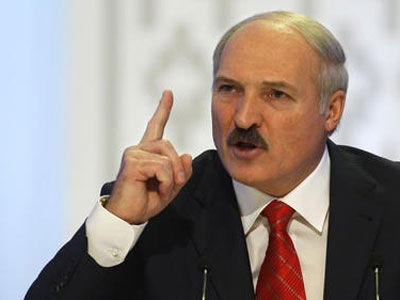
Alexander Lukashenko
Here we proceed from the fact
that the mentality, traditions and way of life of the people cannot be
changed overnight. Must they be changed at all? It cannot be possible to
throw unprepared people into the market abyss—Alexander Lukashenko,
2002
We have once again felt
ourselves a part of the sacred whole, which name is the people of
Belarus. We have made sure: A healthy nation is being formed in our
country. Healthy not only physically, but also spiritually–(Alexander
Lukashenko, 2009)
Alexander Lukashenko is probably the most maligned politician in the
world today. The reasons for this are not difficult to discover.
Contrary to the prattle about his alleged “tyranny,” Lukashenko is under
attack due to his success. Truth be told, of course, Belarus has more
important opposition parties than the U.S., and also has a press that is
part state-owned, but with many legal opposition newspapers in
existence, partly funded by the United States and the EU. Nevertheless,
his success is not based on this.
Lukashenko is victimized because he has proven the economic success
of the social nationalist model, or what he calls the “social market”
model as opposed to libertarian capitalism. There is no doubt this model
has strong national associations, is generally pro-Russian and looks to
the East, rather than the terminally ill West, for its economic future.
Belarus was one of the most essential components of the old Soviet
Union. She is very well educated, specializing in electronics and fuel
transport and refining. This makes her highly strategic and a threat to
the failing West.
Belarus is terra incognita to most Americans, even most Americans who
fancy themselves “experts” in international affairs. Therefore, it
strains the imagination as to why the Western elite, including former
presidential candidate
John McCain, have made attacking Belarus a major aspect of their political life. (Here’s
The Weekly Standard gushing over an Ayn Rand-style economist they want to be president of Belarus; here Michele Brand, writing in
Counterpunch,
exposes the
Western onslaught on Belarus.) The country is the size of Kansas with
little diaspora in America. It seems that the only rational reason for
the constant attacks on this tiny country is that it serves as a means
of attacking Russia—a
neocon bogeyman
if ever there was one. Russian education, gas and oil technology,
scientific establishments and natural resources can be the only rational
reason for this constant drumbeat of rhetorical attacks. The fact that
Russia and Belarus have seen substantial economic growth and increases
in financial capitalization while the West seems forever mired in debt
and social decay is something that embarrasses American “free market
conservatives.”

Lukashenko as depicted by opponents
Recently, McCain seemed to prove the economic subtext of his often
ranting condemnations of Belarus in a recent trip to the Baltics: “We
appreciate the step forward the EU took in adopting the visa ban, but,
we think, it should go further to economic sanctions on energy companies
within Belarus that fuel money for that regime to oppress its own
people.” In fact, when any lengthy discussion of Belarus comes up in
McCain’s political life, energy resources are usually lurking in the
background. McCain
has received
tens of millions from oil firms in America, Israel, the Netherlands and
Britain, and serve as at least the financial reason for this strange
obsession.
Elected in 1994, Lukashenko has popularity ratings that Western
politicians would—and do—envy. Since 1994, Belarus’ spectacular economic
growth, diversification, trade surplus and low unemployment have
maintained the president’s popularity rating at very high levels,
generally hovering around the 60th and 70th percentile. Recently, the
London-based TNS Global Research Organization, polled 10,000
Belorussians as to their President. This shows Lukashenko with a
solid popularity
rating of nearly 75 percent as of the Fall of 2010. Therefore, the
accusations of his rigging elections are nonsense. Even more, his
opposition is highly divided, ineffectual and deeply doubtful as to
their purpose.
What is the basis of his popularity? It’s his sense that Belarus
needs an economic policy that serves its national interests. As the
Russian and Ukrainian economies were devastated and taken out of the
country by
the oligarchs
in the early 1990s with State Department, IMF and Harvard University
backing, Belarus put its privatization program on hold. The IMF was
asked to leave the country, and, from that point on, Lukashenko was
called “the last dictator in Europe.” It is no accident that the bulk of
his U.S opposition comes from Harvard University, especially from the
law school, including
Yarik Kryovi,
who at one point worked for the Soros-owned “Radio Liberty” and served
as a lawyer for the World Bank. His CV lists his work for “private
clients” he will not disclose. The power elite wants Lukashenko’s head
as he continues to become popular among the hoi-polloi of the country.
Lukashenko’s
record is stellar. According to World Bank statistics updated in 2010,
Belarus avoided the recession/depression that has the West in its grip.
Belarussian banks, mostly owned by the state, outperformed all European
banks in 2009. State-owned banks increased their capitalization by
almost 20 percent as the Western taxpayer was forced to bail out the
same banks that have condemned the Minsk government.
From 2001–2008, the
Belorussian economic growth average was
almost 9 percent, which is roughly equal to that of China. As Western
economies were contracting in 2010, the Belarussian economy grew about 6
percent, with a 10 percent increase in agricultural production and a 27
percent increase in exports. Real income, that is, inflation and cost
of living adjusted income, grew by about 7 percent in 2010.
According to the
IMF,
Belarussian unemployment was 0 percent in 1991, but rose to 4 percent
in 1996 as Russian and Ukraine were liquidated from the inside. Under
Lukashenko’s firm leadership in stopping privatization and arresting the
bandits who tried to liquidate the economy, the IMF reports that
unemployment went down to 1 percent in 2008. The United Nations says the
same.
Without exaggeration, these figures, all from hostile sources, show
that Lukashenko’s leadership was and is a success. This is the main
source of his popularity and the reason he is elected and re-elected on a
regular basis. But the important question is what serves as the basis
for Lukashenko’s leadership? The answer is the “social nationalist and
social market” idea. The
official Belarussian doctrine on Development says this:
Belarus has chosen to follow the path of evolutionary
development and rejected the prescriptions of the International Monetary
Fund like shock therapy and landslide privatization. Over many years of
creative work, the Belorussian model of socio-economic development has
been put in place – the model which combines the advantages of market
economy and efficient social protection. Our development concept has
been elaborated in keeping with the historical continuity and people’s
traditions. The Belorussian model aims to improve the existing economic
basis rather than to make a revolutionary break of the former system.
The Belorussian economic model contains the elements of continuity in
the functioning of state institutions everywhere it has proved
effective.
In other words, Lukashenko’s view here is that of a “third way”
between socialism and capitalism. It takes what is good from the free
market but does not dispense with a strong state that makes certain
economic growth is not just for the well-connected few. What Marxism and
capitalism have in common is their results: total inequality in power,
wealth and access. Whether it be the party or the oligarchical class,
these modern, materialist systems serve as little more than massive
transfers of wealth from the working man to the oligarch. Whether these
oligarchs claim to be working “for the people,” “the party,” or
“American freedom” makes no difference. The result is precisely the
same.
In a meeting with his Cabinet and other significant government and
military figures in March of 2002, Lukashenko summarized his political
views. It is worth quoting at length:
What are the distinctive features of our model?
First. Strong and efficient state authority. To safeguard the
citizens’ safety, to ensure social justice and public order, not to
allow expansion of crime and corruption is indeed the role of the state.
Only the strong authority managed to drag the Belorussian economy out
of the economic abyss.
Our nearest neighbors have in the long run realized that, if there is
no strong hierarchy of authority, liberalization of the economy in the
transition period brings about social instability and legal unheard-of
disorder. It results in public unruliness!
As for us, we had a clear idea at the very beginning that premature
expansion of market relations would not allow us to radically resolve
any of the existing pressing problems. On the contrary, new problems
would emerge, generated by the specificity of the market relations.
Public accord would break, resulting in conflicts and instability. And
it is political stability that is one of the main conditions for gradual
integration into the world economy. I would refer to it as one of the
distinctive features or consequences (whatever you call it) of the model
of development of the Belorussian economy.
Here we proceed from the fact that mentality, traditions and way of
life of the people cannot be changed overnight. Must they be changed at
all? It cannot be possible to throw unprepared people into the market
abyss. One needs decades to work out a new world outlook.
The second distinctive feature of our model is in the fact that the
private sector can and has to be developing alongside the public sector.
But not to the detriment of national interests. I emphasize: if you are
a private owner, it does not imply you should do whatever you like.
National interests, the state, must be the main priority and the main
goal for the work of every citizen, enterprise or entrepreneur whose
production is based on private ownership.
This is not campaign rhetoric, but serves as the basis of government
policy since the mid 1990s. The state must be strong, honest, and
competently led, because the alternative is oligarchical control and the
substitution of private for public law. The state is taking a
protective stance towards its people—a novel idea in an age with
Western elites
have systematically undermined the interests of their own people,
particularly with regard to immigration. As the Soviet Union fell to
pieces, only the state remained to safeguard some minimal concept of the
public good. Russian under Yeltsin and IMF control was incapable of
this, proving the incompetence and corruption of such multinational
agencies. Only in Belarus was this economic rape stopped.
The ignorance of the “free marketeers” is shown in their views on
Russia. They assumed around 1991 that if the government just “got out of
way” of the “invisible hand,” all would be well. What they did not
count on was the radical inequalities of access to power. Those with
good government jobs, black market fortunes or other forms of “gray”
access to power were precisely those who were in the best position to
take power. Under the weak leadership of Yeltsin and the IMF, the
Russian economy almost disappeared. The work of decades of the Russian
people was liquidated and sent to America, Cyprus, Israel and Latin
America in the name of “freedom” and “democracy.”
The “free market” is a slogan—a mode of legitimizing the already
extant distribution of power. There was never a time of the pure “free
market,” but rather, it existed only because of the abilities of those
capable of taking over during the decay of Ancien Régime-Europe in the
Enlightenment. The old social protections of the medieval peasant and
townsmen were thrown by the wayside in this oligarchic rush for
progress, money and power. The same thing happened in Russia and Ukraine
in the early 1990s. Weak leadership meant the liquidation of the state,
economy and legal system. In his 2009 New Year’s Address, Lukashenko
added
more detail to his basic approach:
We were urgently recommended to place the economy under
the command of the rules of the world exchange market. But we decided
not to rely on the volatile exchange trends.
We are not the ones who have provoked today’s crisis which is sending
shockwaves all around the world. On the contrary, the crisis has come
as a result of something that we have been always been determined to
struggle against.
The central words are this: “I emphasize: if you are a private owner,
it does not imply you should do whatever you like.” It is the nation
that comes first. The nation here is the bilingual tradition of Belarus
between Russian and Belarussian. It is Slavic Orthodox and agrarian. It
is based on a fundamentally egalitarian distribution of land and
resources in the name of ethnic and national solidarity. Economic
progress means nothing if it benefits only the few. Nationalism implies
solidarity, especially in a small and vulnerable country under constant
attack.
In his famous essay “On the Historical Choice of Belarus,” the more
“ethnic” aspects of his political theory are laid out. In general, the
purpose of the state, in this realm, is to provide a safe home for the
specific traditions of the peoples living within it to flourish. This
includes the agrarian culture, urban life, the specific ethnic
traditions of Poles, Belorussians and Russians living within Belarus.
The point is not so much that the state is representative of a specific
national tradition, but rather that preserving the national traditions
of the peoples living within her borders becomes paramount. There are no
real ethnically pure states, and therefore, the best the state can do
is protect the ethical traditions and regional variations that do exist.
In his April, 2002 State of the Union Address, Lukashenko stated:
Rights and freedoms must be in harmony with
responsibilities for violations of the state-established regulations.
Development of the Belorussian economy implies not only the
encouragement of small and medium-sized enterprise (although, as I said,
these must and will be encouraged). Historically, the Belorussian
industry means large-scale enterprises. There is only one promising way:
updating and re-equipping existing major industries so as to produce
competitive new generations of products. Just look, the entire world
merges into transnational corporations. Why then should we crush, divide
and destroy our gigantic highly cooperated enterprises? They must be
relied upon. In pursuing its policy, the state will, first of all, be
relying upon these giants, which have been maintaining us and feeding
us. Immense investments are needed for this, which cannot be attracted
without changing the form of ownership. (Translation mine, available
only in Russian)
His doctrine of “social right” is that there are no abstract rights.
They are contextualized into a way of life—that of the national
collective. You have no right, for example, to do something that harms
the economic life of the country. Rights in the West are mindless slogan
words without meaning. They exist to end an argument without making
your case: “I have a right to do this” the American businessman might
say as he outsources is jobs to China. Justifying such an alleged
“right” is another matter, but the very act of claiming a “right” to do
something shuts down all argument. Lukashenko asks, not what are your
“rights,” but what is the “good” thing to do. No one has a “right” to
undermine the public good, especially for private profit. The entire
point of law is to protect labor from the arrogance and
currency-fetishism of the ruling class. Only strong leadership able to
go over the heads of the powerful can fashion such laws. Lukashenko and
Belarus have reaped the benefits of such a policy.
In confronting the onslaught of the West in his 2006 State of the Union Address, Lukashenko spared no feelings:
The country’s development policy line worked out by us
has proved right. High rates of economic growth, which our economy has
been already demonstrating for more than 10 years, provide good evidence
thereof. Just compare: our annual GDP growth over the past five–year
planning period was 7.5 percent as against 3.5 percent of the world
average.
Western theoreticians fail to explain the reasons of such a success. They do not fit in with their “democratic” scheme.
The reasons, however, are simple. We have not embezzled the people’s
wealth, we have not got into burdensome debts. Relying on life itself,
we have worked out our own model of development based on well–balanced
and thought–out reforms. Without any sweeping privatization and shock
therapy — preserving everything that was best in our economy and in our
traditions. At the same time we have been learning to work under new,
market conditions, taking advantage of the experience elsewhere in the
world and taking into account the modern trends of the world economy.
Strong state power, strong social policy and reliance on the people—
that is what explains the secret behind our success. (Translation mine,
available only in Russian)
Liberal democracy in the West has meant, in real terms, the constant
transfer of the labor of the American worker to the pockets of the banks
and the multinational firms. When the banks failed, they demanded
trillions from these same taxpayers to continue to lend. Much of this
money just went overseas and into the pockets of the major players like
Goldman-Sachs. In the 2008 elections,
Goldman
spent a huge amount of money on both candidates. Whoever won in 2008
saw Goldman as their primary beneficiary. This is liberal democracy, and
this is a large part of the American failure.
In sending the Western oligarchs packing, Lukashenko did two things:
first, he assured his own popularity and political success while,
second, earning the hatred of the Western establishment. It should be
noted that at the 2010 Bildeberg meeting, not a single Russian or
Belarussian was invited. The same was true in 2011. (Jim Tucker,
personal communication)
In his “Historical Choice” essay, Lukashenko condemns the form of
Free Trade practiced by the EU. For him, the playing field is already
slanted to the elites in the powerful states of the union. In the EU—he
is writing in 2003—states like Greece or Portugal could not compete with
the advanced states of Germany or England. The benefits that Greece
takes from the EU exist solely in the interests of the ruling classes,
while the people suffer. German or French goods flood the Greek market,
putting Greek artisans out of business.
When Lukashenko uses the word “independence,” it is meant not just as
a campaign slogan, but as a moral reality. Independence means economic
independence—the global market will be entered on our terms, not the
banks’. Independence means that, while Belarus will always be an
Orthodox and Slavic people, that does not mean issues of justice will be
ignored in Minsk’s choice of allies. There is to be no dependence on
anyone. Dependence on other states for energy, markets or industrial
components automatically means that the people themselves have lost all
power over their economic lives, and their well-being in that sense is
solely in the hands of others, foreigners. For Belarus, the worker will
be involved in all levels of economic decision making and will have some
control over the economic life he enjoys.
When commemorating the 60
th anniversary of the (Bolshevist) massacre of Katyn in March of 2003, Lukashenko said
this:
We still have to analyze and learn lessons from current
events. But already today it is clear: the system of the world order has
been destroyed due to the war in Iraq, the role of the UN Security
Council has been brought to zero, international law has been trampled
underfoot, the principle of no external imposition to any people of the
system of governance and power has been violated. The Belorussian people
condemn the aggression by the United States of America. So do most of
the peoples and states of the world, including even the closest allies
of the USA.
Lukashenko has consistently promoted that United Nations as a means
of controlling American imperial power. Furthermore, he appreciates that
the UN would include the views of poorer states throughout the world in
foreign policy decisions. Lukashenko has rejected any form of global
government, but still sees a constructive role for some international
organizations in protecting the weak against the strong. He stresses the
“principle of no external imposition” of state forms or ideology on a
people. Lukashenko condemns America’s ideological crusade for oil,
Israel and the oligarchic doctrine of “liberal democracy.”
Lukashenko sees ideological crusades not as moral interventions or
manifestations of dis-interested humanitarianism, but cloaks for raw
oligarchical power. In Lukashenko’s ethical theory, oligarchy is the
worst form of government. Historically, from Novgorod to Venice to New
York, oligarchies have used liberalism, “republicanism,” and media
manipulation as a cloak for their own power. In a similar vein,
Lukashenko states in his 2006 address to the heads of Belarus’
diplomatic corps:
If we are talking about respect for states, their
independence and sovereignty, their rights to choose their futures,
about the right of the people to elect its leaders, about respect of the
right to life and free labor, worthy wages and salaries, the right to
equality of all before the law, the right to freedom of opinion and
expression in conformity to the law, without detriment to the rights of
other people — these are our values. The U.S. and the EU do not have a
monopoly on these rights. Our nation had paid a far greater price for
these values than the USA and the EU.
As always, Lukashenko shows the distinction between a politician and a
statesman. It is concepts like these that have helped this man become
one of the most popular politicians in the Slavic world. Again, the
Belarussian President holds abstract “rights” as little more than cloaks
for raw oligarchic power. The U.S. invades the rights and sovereignty
of other states not to protect people from “human rights abuses,” but
rather, to serve the interests of its overgrown and excessively wealthy
private sector.
While the Western press continually repeats the inaccurate statement
that Belarussian media is “state-owned,” they themselves hew to a single
line on most important topics, especially on foreign policy. Needless
to say, the oligarchic control over Western media is too well known to
deserve further comment.
The very fact that the President of Belarus holds that Western
hostility is due to “external influences” strongly suggests that he is
referring to financial and ethnic sources of power. This is important,
since it goes to the heart of his social ideas. The state, at its best,
is a source of moral authority and the public good. When the state is
captured by alien elements, it then becomes merely a coercive agency of
oligarchy. Therefore, in a rather roundabout way, Lukashenko is making
the accusation that Western states are not public, but rather private,
entities. If they were to become public entities once more, they would
then drop their hostility to the Belarussian political system.
Conclusion
In grasping the political ideas of Lukashenko outside of its media distortion, many themes come up repeatedly:
- A nationalism that stresses the economic security of his small
country. Ethnicity and religion are important because they serve as a
basis of solidarity for the basic economic concerns of the people.
- The continual attack on “abstractions,” such as “human rights” or
“economic freedom.” Since abstractions can mean whatever the speaker
wants them to mean, they are used as covers for the exercise of
colonialism and economic imperialism.
- In cases of emergency, such as the meltdown of the Russian and
Ukrainian economies in the early 1990s, the state has the responsibility
to take the lead in protecting the population from oligarchy and
foreign attack. This is especially the case in smaller and hence more
vulnerable states.
- No state can function when it is penetrated by oligarchy and the
“free market” ideology. These care only about private goods, while the
state serves the public good only. The state serves the public good when
it uses its authority against concentrated economic power and
self-interested foreign interference.
- The state understands its role only in light of the historical experience and ethnic tradition(s) of its people.
- Economics exists for the whole people. If it does not serve the
public good, then it has no moral legitimacy, regardless of all “rights”
talk to the contrary.
- The state has a legitimate economic role in both media and
economics. It has no right to rule these in a totalitarian fashion, but
it, especially in times of stress, has a right to have its voice heard. A
strong state sector is not the same as “tyranny.”
- There is no real moral distinction between state control and oligarchic control.
- The media is one of the world’s most powerful weapons. Hence, it
should be regulated like any other weapon. Media elites are often
oligarchical and centralized, and use their empires for the sake of
controlling others. A free media, therefore, is a mixed one, with
different points of view being permitted. This is far more the case in
Russia and Belarus than it is in the US.
- No government has the right to manipulate the internal affairs of
another. This is especially the case when such interference is blatantly
self-interested and serves the interest only of an economic oligarchy.
- “The people” is another of these abstractions that mean nothing. To
use the phrase “the people,” the speaker must be referring to a
specific people, a specific language and historical tradition, as well
as a specific social context.
- International justice, if it means anything, refers to a state of
affairs where the world’s ethnic groups, races and religions are given
the independence to develop according to their own historical tradition,
not the ideological slogans of the current hegemon.
- International justice also implies objective and politically neutral
international bodies that can mediate disputes outside of an
ideological agenda. This is far from “world government,” but refers only
to certain arrangements that can solve international problems in a
neutral manner before they lead to mass warfare. This is especially
sensitive in smaller states that have lost huge percentages of their
population in wars. The fact that Belarus lost
almost 30 percent of its population in the Second World War makes the
average Belarussian a bit testy about the possibility of another
shooting war on its soil.
Matt
Johnson is a professional writer a former university professor
specializing in Russian and Ukrainian history and theology. His doctoral
dissertation at the University of Nebraska was on the nature of
scientific methods as a conduit for political revolution. He has taught
both at the University of Nebraska-Lincoln and Mount
St. Mary’s University. He is the author of 5 books, the most recent is Russian Populist: The Political Theory of Vladimir Putin published by the Barnes Review Press. He hosts a radio program, The Orthodox Nationalist, on the Reason Radio Network.